
Why Tire Pressure Is the Most Underrated Off-Road Mod You’re Not Doing
Airing down your tires before hitting the trail is one of the single most effective things you can do for off-road performance — and most new wheelers either skip it entirely or do it halfway. You can bolt on a two-inch lift, add a locker in the rear, and spend three grand on an ARB bumper with a winch — and you’ll still get stuck on a wet sand dune if your tires are aired up to 35 PSI. Tire pressure management is one of those things experienced wheelers treat as second nature, but it trips up newcomers more than almost anything else. Get it right and your rig transforms on the trail. Get it wrong and you’re digging out before lunch.
This guide covers everything: why airing down actually works (the physics behind it), how low to go on different surfaces, the tools that make deflating and inflating painless, and the best portable compressors I’ve tested and used. Whether you’re running 33s on a Jeep TJ or 37s on a full-size truck, this stuff applies to you.
The Physics: What Airing Down Actually Does
When you reduce tire pressure, the sidewall flexes outward and the contact patch — the footprint of rubber touching the ground — gets longer and wider. On a 35-inch tire, dropping from 32 PSI down to 15 PSI can increase the contact patch area by 40% or more. That means more rubber gripping the rocks, more flotation over sand, and better absorption of trail chatter so your rig isn’t bouncing all over the place.
On soft surfaces like sand and mud, wider contact patch means lower ground pressure. Think of it like snowshoes — spread the load and you sink less. On rocky terrain, the flexing sidewall literally molds around rocks instead of riding over them, which improves traction dramatically and protects your wheel bead from impact damage.
The side effects are all positive for off-road: smoother ride, less trail fatigue, lower chance of a sidewall puncture from pinching between a rock and the rim. The only trade-off is time — you have to air back up before getting on pavement, and that’s where a good portable compressor earns every dollar you spent on it.
Finding Your Baseline PSI
Before you can talk about airing down, you need to know where you’re starting. For most vehicles, highway PSI is printed on the door jamb sticker — not on the tire sidewall (that’s the maximum rated pressure, not the recommended operating pressure). Write that number down. That’s your on-road starting point.
A few factors affect how far you can air down before you risk unseating the bead (separating the tire from the rim, which is as ugly as it sounds):
- Tire size: Larger tires have more sidewall and can handle lower pressures safely.
- Rim width: Wider rims support the bead better at low pressure. A 35-inch tire on a 9-inch wide rim can safely go lower than the same tire on a 7.5-inch rim.
- Beadlock wheels: Mechanically lock the bead to the rim. With beadlocks you can air down to 5–8 PSI without fear. Without them, be cautious below 12 PSI.
- Load: A heavily loaded overlanding rig (rooftop tent, full gear, passengers) should air down slightly less than an empty one — the extra weight already helps seat the bead.
If you’re building out a serious overlanding rig, check out our Overlanding 101 guide for a full breakdown of weight management and gear considerations before you hit multi-day trails.
The Cheat Sheet: PSI Recommendations by Surface
These ranges work for most 32–37 inch tires on standard street wheels (no beadlocks). If you’re running very small tires (under 30″) or very large ones (40″+), adjust accordingly.
Paved Roads / Highway
Use your door jamb spec. Typically 30–40 PSI depending on vehicle. Never wheel on pavement aired down — heat buildup and handling degradation are real risks.
Maintained Gravel / Forest Service Roads
26–30 PSI. A modest reduction takes the edge off washboard roads and protects sidewalls from sharp gravel. The difference in ride quality is noticeable even at these conservative pressures.
Hard-Pack Dirt and Two-Track
22–28 PSI. Firm surface means you don’t need dramatic flotation, but some flex helps on ruts and roots. Good compromise between comfort and performance.
Rocky Trails (Moderate to Technical)
18–22 PSI. This is where airing down really pays off on rocks. The sidewall wraps around ledges and provides grip you simply cannot get at street pressure. Drop to 15 PSI on very technical rock crawls if your setup allows it.
Loose Dirt, Decomposed Granite, Dry Sand Dunes
18–22 PSI. Medium-weight loose surface — the contact patch expansion improves traction without risking bead loss.
Wet Sand, Soft Coastal Beaches
14–18 PSI. Flotation is everything here. Standard PSI on a beach will have you sinking like a stone. I’ve driven on coastal beaches at 14 PSI in a loaded Jeep TJ and floated right across sections that swallowed other vehicles.
Deep Mud
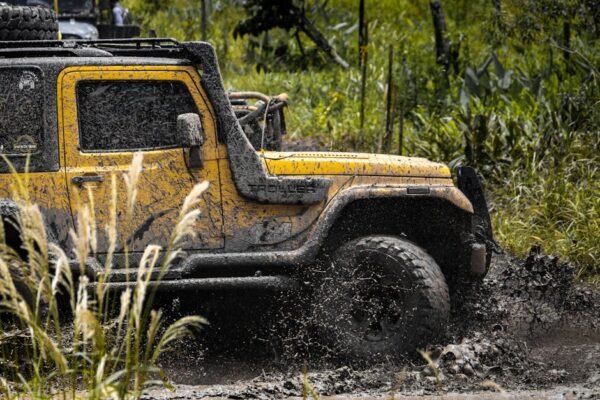
15–20 PSI. Counterintuitively, you don’t always want to go super low in mud. The aggressive tread needs to cut through, not just float. Keep some pressure for tire rotation to self-clear mud. Depends heavily on your tire design.
When technical terrain turns into a recovery situation, having the right gear matters as much as tire pressure. Check out the top 10 must-have recovery gear items if you’re still building out your kit.
Deflation Tools: Faster Than a Valve Stem Cap
You can use the back of a key to depress a valve stem and bleed air out manually. That works. It also takes about eight minutes per tire and your back will hate you. Here are better options:
Schrader Valve Deflator Caps
These are simple screw-on caps with a pin that presses the valve stem when you thread them on. Remove your stock cap, screw on the deflator, walk away. They slow the deflation automatically. Cheap ($10–$15 for a set of four), dead simple, and they work. The downside: no precise pressure target — you have to check with a gauge periodically.
Staun Automatic Deflators
The real step up. Staun deflators are pre-set to a specific target PSI (they come in ranges like 6–14 PSI or 14–25 PSI). You thread them on, they deflate to the preset pressure and stop automatically. Set all four, walk around the rig once or twice, they’re done. I run a set of the 14–25 PSI range Stauns for most trail work and it takes maybe 90 seconds total to hit all four tires and walk away. Runs about $65–$80 for a four-pack — worth every cent.
ARB E-Z Tire Deflators
ARB’s offering has a built-in gauge so you can set the exact target PSI with a dial. Thread it on, it deflates to your setting and stops. Clean, accurate, and built like ARB typically builds things. Runs about $80–$90 for a four-pack. If you want the most precise control, these are the ones to get.
Manual Bleed + Gauge
Carry a quality digital tire gauge, depress the valve stem, check frequently. Tedious, but gives you full control and costs nothing beyond the gauge ($15–$25 for a decent digital). Fine for occasional use if you’re not willing to invest in deflators yet.
Airing Back Up: The Portable Compressor Deep Dive
This is where people cheap out and regret it. A $30 inflator from a big-box store will inflate one tire in about 20 minutes and then overheat and die. Here’s what actually works in the field.
ARB Twin Air Compressor (the gold standard)
If you have a serious rig and wheel regularly, the ARB Twin is the answer. Dual-cylinder design, 100% duty cycle (it can run continuously without overheating), and it pumps out 6.16 CFM — enough to put 35-inch tires back to trail pressure in about 3–4 minutes per tire. Permanently mounts under the hood or in a drawer system. The CKMTA12 runs around $500–$550.
That price makes people flinch, but consider: you use this thing every single trip. It’s a component, not a gadget. The ARB Twin has been bulletproof for me through years of desert wheeling and mountain trails. If you also run ARB air lockers, you need this compressor anyway — it runs those too.
Viair 400P Automatic
The sweet spot for a capable, portable compressor without the ARB price tag. Clamps directly to your battery, runs up to 150 PSI output, with a 35% duty cycle (it can run for about 35% of any given hour before it needs to cool down). For most people airing up after a trail, that duty cycle is fine — you’re not inflating tires continuously. Fills a 35-inch tire to 35 PSI in about 4–5 minutes. Costs around $150–$175. The Viair comes with a 30-foot hose which is long enough to reach all four corners of most rigs without moving.
The Viair 450P bumps up to 45% duty cycle and 150 PSI for about $50 more. If you’re running 37s or larger, go for the 450P.
Smittybilt 2781 Universal Air Compressor
Budget-friendly at $100–$130, 2.54 CFM, 100 PSI max. Functional for most weekend warriors on 33–35 inch tires. The build quality isn’t ARB, and the duty cycle will limit you on hot days airing up four large tires back-to-back. But it works, it’s affordable, and thousands of Jeep owners have used them for years without issues. A solid starting point if you’re not ready to drop $500 on the ARB.
CO2 Tank Systems
A 20-pound CO2 tank with a proper regulator and air chuck can fill a 35-inch tire from 14 PSI to 35 PSI in under a minute. Fast, silent, no battery draw. The downsides: CO2 is cold (can temporarily mess with TPMS readings), the tank needs to be refilled at a welding supply store (not everywhere), and each 20-pound tank is good for roughly 8–12 tires depending on how empty they are. Great for group trips or as a complement to a compressor. Unnecessary as a sole inflation source for solo travel.
Quick Compressor Comparison
CFM figures are manufacturer-rated at free flow (0 PSI back-pressure). Real-world fill times depend on starting tire pressure and ambient temperature.
| Compressor | CFM | Duty Cycle | Mount Type | Price | Best For |
|---|---|---|---|---|---|
| ARB Twin (CKMTA12) | 6.16 | 100% | Permanent | ~$540 | Serious overlanders, ARB lockers |
| Viair 450P-A | 1.80 | 45% | Portable (battery clamps) | ~$225 | Weekend warriors, 35–37″ tires |
| Viair 400P-A | 1.47 | 35% | Portable (battery clamps) | ~$160 | Most 33–35″ tire rigs |
| Smittybilt 2781 | 2.54 | ~30% | Portable (battery clamps) | ~$110 | Budget builds, smaller tires |
| CO2 Tank (20 lb) | N/A | 100% | In-vehicle storage | ~$150 + refills | Speed, group trips |
Accessories That Make the Difference
Quality Tire Pressure Gauge
Get a digital dial gauge with a bleed valve. The $5 stick gauges that come free with compressors are notoriously inaccurate. A Milton S-921 or Accutire MS-4021B runs $15–$25 and will give you consistent, accurate readings. Accuracy matters more at low pressures — the difference between 14 and 17 PSI is significant in the sand.
Inflation Hose Extensions
Most portable compressors include a 20–30 foot hose, which covers most vehicles. If you’re on a full-size truck or have a permanent compressor mounted in the front, a longer hose extension ($20–$30) prevents the awkward dance of moving the compressor between corners.
Air Pressure Management App
Sounds silly, but apps like OnX Offroad (which also does trail navigation) let you log your preferred PSI per trail type in your trip notes. Not critical, but useful when you’re building your own cheat sheet for your specific rig over time.
TPMS Awareness
Most modern vehicles with factory TPMS will throw a warning light when you air down to trail pressure. This is normal and expected. Some aftermarket TPMS systems (like the Tymate M01) let you set custom alert thresholds per wheel — useful if you want real-time monitoring at trail pressures without constant alarm lights.
The Routine: What to Do Before and After Every Trail
- Check highway PSI before leaving home. Start with a known baseline. Inflate any underinflated tire before you get to the trailhead.
- At the trailhead, assess the terrain. Rocky? Sandy? Mixed? Decide your target PSI before reaching for the deflator.
- Air down all four tires equally. Uneven pressure front-to-back can create unexpected handling quirks. Go equal on all four.
- Drive slowly until you verify the feel. Tires at 15 PSI handle very differently than street pressure. Give yourself a minute to adapt before attacking technical terrain.
- Carry a gauge and check mid-trail if the surface changes dramatically. Going from rock to deep sand? Consider airing down another 2–3 PSI.
- Before pavement, air back up fully. This is non-negotiable. Driving on pavement at trail pressure overheats tires, kills handling, and dramatically increases the risk of a blowout. Take the 10 minutes to air up properly.
- Check pressures again after airing up. Compressors can overshoot the target. A quick check of all four before you hit the highway takes 60 seconds.
None of this replaces the basics of trail prep. Before any serious trail, make sure your recovery gear is sorted — recovery gear essentials covers the kinetic ropes, traction boards, and hi-lift jack setup you’ll want when things go sideways, because even with perfect tire pressure management, trails have a way of surprising you. And when you’re camping out between trail days, good camp kitchen organization makes the whole trip better — our trail cooking guide has the gear and meal ideas to keep everyone fueled.
My Personal Setup (2026)
For my Jeep TJ with 35-inch BFGoodrich K02s on 9-inch wide steel wheels (no beadlocks), here’s what I’m running:
- Highway PSI: 35 front / 35 rear (slightly loaded)
- Forest roads: 26–28 PSI
- Rocky technical trails: 18–20 PSI
- Sand: 15–16 PSI (my hard floor without beadlocks)
- Deflators: Staun 14–25 PSI set for most trips, ARB E-Z for precise sandy beach runs
- Compressor: ARB Twin permanently mounted, because I also run ARB air lockers and the dual-purpose utility is worth every penny
- Backup: 10-pound CO2 tank behind the seat for emergencies and group trips
If I were building a budget setup from scratch, I’d grab the Viair 400P-A (~$160) and a set of Staun deflators (~$70) and call it a day. That $230 combo handles 90% of trail situations effectively, and you can upgrade the compressor later if you go deeper into overlanding.
Bottom Line
Airing down costs you nothing except time — and with the right deflators and compressor, it doesn’t even cost much of that. It’s the single highest-return modification you can make to your trail capability without actually modifying anything. Lower your tire pressure correctly, air back up before pavement, and repeat every single time.
If you take away one thing from this guide: invest in a set of automatic deflators and a Viair 400P (or better). The 10 minutes you save at the trailhead and trailhead exit over the course of a season adds up to real time, and the capability improvement from properly managed tire pressure is immediate and dramatic.
Get out there, air down, and drive something worth airing down for.